AI Agents for Coaches: How to Automate Your Coaching Business Without Losing the Human Touch
Discover how AI agents can help coaches automate content, marketing, client communication and business operations without replacing the human side of coaching.
By Gopal Krishnan, India's Unicorn Maker

Build your ₹1 Crore coaching business with the 1 Crore Coach Plan
Learn the niche, offer, content and AI systems that let you scale without doing every task yourself. Free seat, limited slots.
Reserve My Free SeatRunning a coaching business can feel like doing five jobs at once.
You coach clients. You create content. You respond to enquiries. You follow up with leads. You manage your calendar, marketing, operations and client communication.
As the business grows, the problem often isn't a lack of knowledge. It is a lack of capacity. There are only so many hours in a day, and coaches can easily find themselves spending more time running the business than actually coaching.
This is where AI agents for coaches are becoming increasingly relevant. Unlike a traditional AI chatbot that waits for you to give it a prompt, AI agents are designed to perform specific tasks and workflows with greater autonomy. The broader AI market is moving toward agents that can assist with repetitive business processes rather than simply generating text or answering questions.
What if AI could become part of your business team rather than simply another tool you use?
What Are AI Agents for Coaches?
An AI agent is an AI-powered system designed to perform a specific role or set of tasks based on defined instructions, information and workflows.
Think of the difference between asking an AI chatbot “write me an Instagram caption” and having an AI content agent that is configured to:
- understand your audience
- follow your brand voice
- use your content pillars
- turn an idea into a post
- create variations
- organise the content
- and move it into your publishing workflow
The first example is an AI tool. The second starts to resemble an AI team member.
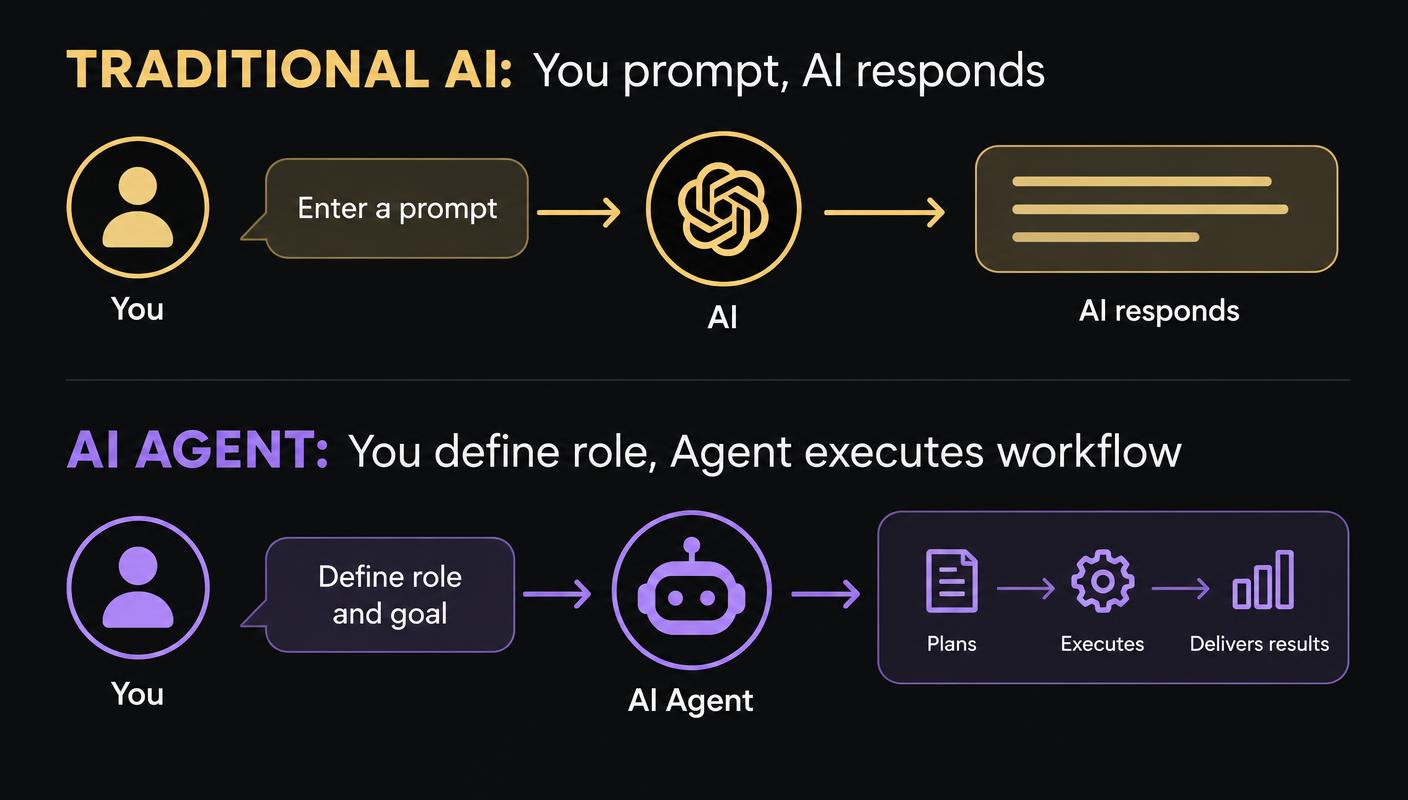
For a coaching business, AI agents can support content creation, lead qualification, client follow-ups, marketing workflows, research, operations and administrative tasks. The important distinction is that AI agents should not be viewed simply as replacements for people. Their greatest value is in taking repetitive work off the coach's plate.
Why Coaches Need More Than Another AI Writing Tool
Most coaches have already experimented with AI to write social posts, brainstorm ideas, draft emails, summarise information, develop workshop content or research topics.
That saves time. But it doesn't solve the biggest operational problem. You still have to open the tool, write the prompt, review the output, edit it, move the information somewhere else, remember the next task, and repeat the process tomorrow.
The question is shifting from “What can AI create for me?” to “What recurring work can AI help me execute?”
7 Ways AI Agents Can Support a Coaching Business
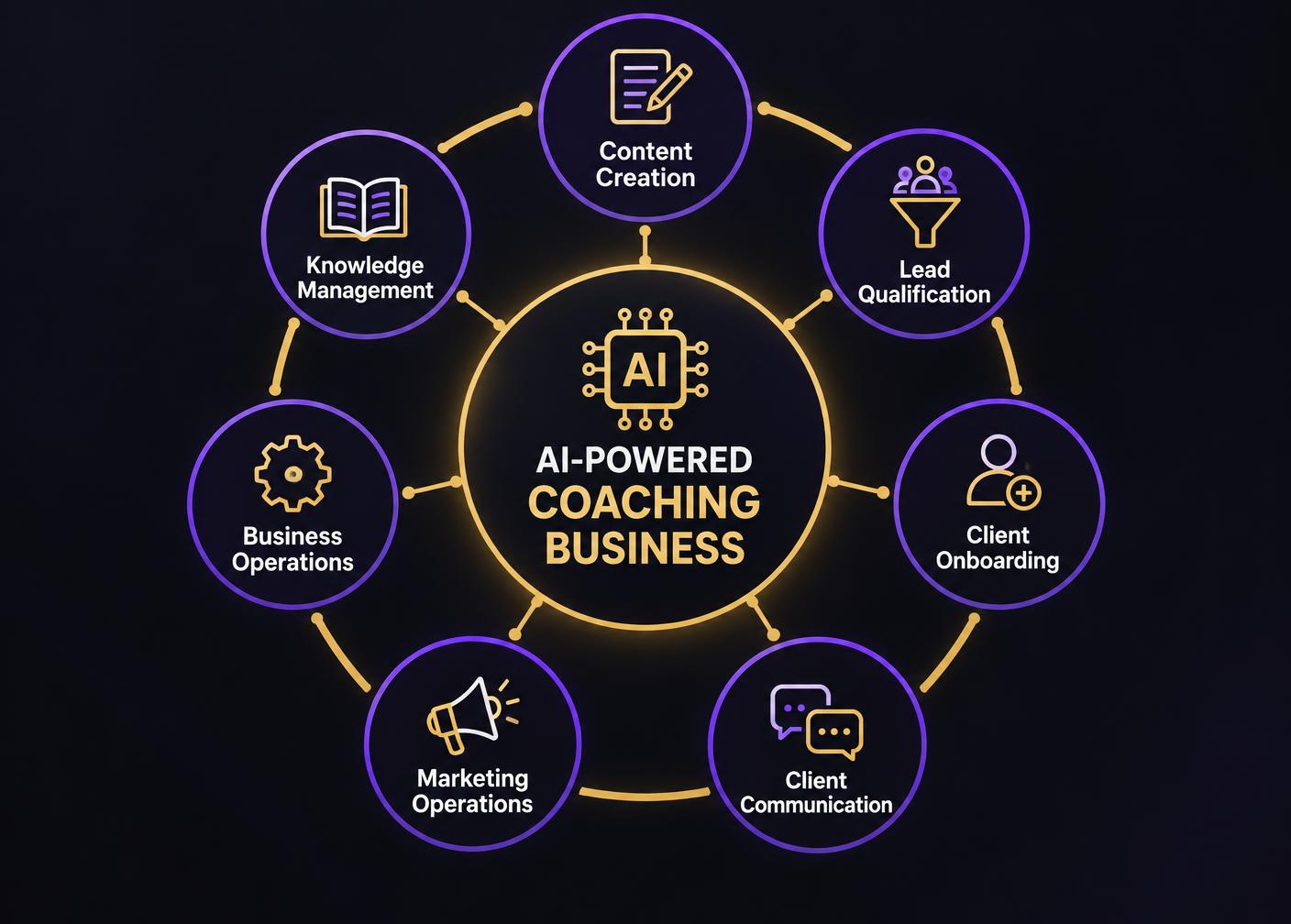
1. Content Creation
Content becomes a significant time drain. You need ideas, posts, emails, videos, articles and promotional material consistently. An AI content agent can be configured around your niche, audience, content pillars, positioning, tone of voice, frameworks, offers and frequently asked questions. Instead of starting from a blank page, you build a system around the knowledge you already have.
2. Lead Qualification and Follow-Up
A prospect may discover you today but not be ready to book a call. The coach gets busy, the follow-up gets delayed, the lead loses interest. AI agents can respond to enquiries, ask qualifying questions, share relevant information and support follow-up workflows, reducing the repetitive communication that needs your direct attention.
3. Client Onboarding
Welcome messages, forms, information collection, process explanations, resources, first-session scheduling and reminders. Individually small, together they create friction. An AI-powered workflow standardises onboarding so every client gets a consistent experience.
4. Client Communication
“When is our next session?” “Where can I find this resource?” “How should I prepare?” AI can handle the predictable layer while you stay responsible for the conversations that need judgement and empathy.
5. Marketing Operations
Marketing isn't only content. There are campaigns to plan, leads to track, emails to send, pages to update, follow-ups to manage and performance data to review. AI agents can support these recurring workflows rather than just generating individual pieces of content.
6. Business Operations
Client records, task lists, payment follow-ups, meeting notes, recurring reports, team communication, scheduling and document management. These aren't why you became a coach, but they consume time. AI agents can coordinate them so fewer tasks depend on you remembering.
7. Knowledge Management
A coach accumulates frameworks, methodologies, workshop material, books, articles, client questions, case studies and processes. Instead of leaving that scattered across documents, an AI system can be organised around your knowledge base. You're no longer using AI to generate generic information; you're teaching your systems how your business thinks.
AI Agents Should Work From Your Intellectual Property
Your competitive advantage isn't that you know how to use AI. Thousands of people use the same tools. Your advantage is your experience, methodology, frameworks, processes and client insights.
Imagine an AI assistant built around your own methodology. It understands:
- the language you use
- the principles you teach
- the questions you ask
- the structure of your programmes
- your client journey
- your communication style
Now AI isn't producing generic coaching content. It is helping operationalise your intellectual property.
What AI Should Not Replace
Coaching is fundamentally human. AI can organise information, automate workflows, generate drafts, analyse patterns and handle repetitive communication. But a client may say one sentence that reveals something important. A coach notices hesitation in a voice. A difficult conversation requires empathy rather than automation. A breakthrough happens because the coach asks an unexpected question at the right moment.
AI for the repetitive work + human expertise for the transformative work.
The Goal Isn't to Work Faster. It's to Create More Capacity.
If you automate ten tasks and then use the extra time to take on ten more administrative tasks, you haven't changed your business. The real question is: what would you do with the time AI gives back to you? More client conversations? Better programme design? Speaking? Family? Rest? Your next offer?
From AI Tools to an AI Workforce
First coaches used AI for answers. Then for content. Now businesses are exploring AI for workflows and execution. The next step is thinking about AI as a set of specialised roles:
- Content Agent → supports content production
- Marketing Agent → supports campaigns and marketing workflows
- Sales Agent → supports lead qualification and follow-up
- Client Agent → supports onboarding and communication
- Operations Agent → supports recurring business processes
Don't ask AI to replace your expertise. Build systems that allow your expertise to operate at greater scale.
How to Start Using AI Agents in Your Coaching Business
- Step 1: List what you repeat every week.
- Step 2: Separate tasks that don't require deep human judgement.
- Step 3: Identify the task consuming the most unnecessary time. Start there.
- Step 4: Document how you currently do it. AI works better when the process is clear.
- Step 5: Build one workflow before building ten.
- Step 6: Keep a human review layer for client-facing and sensitive work.
- Step 7: Measure the time saved. The purpose is capacity, not collecting tools.
The Future of Coaching Isn't Less Human
The more AI handles repetitive work, the more valuable the distinctly human side of coaching becomes. AI cannot manufacture the trust between a coach and a client, or replace the experience of being deeply understood. The opportunity isn't to make coaching less human. It is to use technology to remove the work that prevents coaches from being more human.
Final Thoughts
AI agents represent a shift from using AI as a tool to designing AI-supported business systems. For coaches, that means less time on repetitive administration, content production, follow-ups and operations, and more capacity for the work only a human coach can provide.
A better question than “How can AI help me create content?” is: “What parts of my coaching business could keep moving forward without requiring me to manually do every step?” The answer could be the beginning of a very different way of building a coaching business.
Frequently Asked Questions
What are AI agents for coaches?
An AI agent is an AI-powered system configured to perform a specific role or workflow for your coaching business, such as content production, lead qualification, client onboarding or operations, based on your instructions, brand voice and knowledge base. Unlike a chatbot that waits for a prompt, an agent executes a defined process.
How is an AI agent different from ChatGPT?
With a chatbot you prompt and it responds. With an AI agent you define a role, give it your context and workflow, and it executes the steps repeatedly. The chatbot is a tool; the agent behaves more like a team member.
Will AI replace coaches?
No. AI can organise information, automate workflows, draft content and handle repetitive communication. It cannot build trust, read hesitation in a client's voice or guide a transformation. The workable model is AI for repetitive work plus human expertise for transformative work.
Where should a coach start with AI automation?
Start with one repetitive weekly workflow that does not require deep human judgement, document how you currently do it, build a single agent around it, keep a human review layer for client-facing output, and measure the time saved before adding a second agent.
Which parts of a coaching business can AI agents support?
Content creation, lead qualification and follow-up, client onboarding, client communication, marketing operations, business operations and knowledge management.
Build your ₹1 Crore coaching business with the 1 Crore Coach Plan
Learn the niche, offer, content and AI systems that let you scale without doing every task yourself. Free seat, limited slots.
Reserve My Free Seat